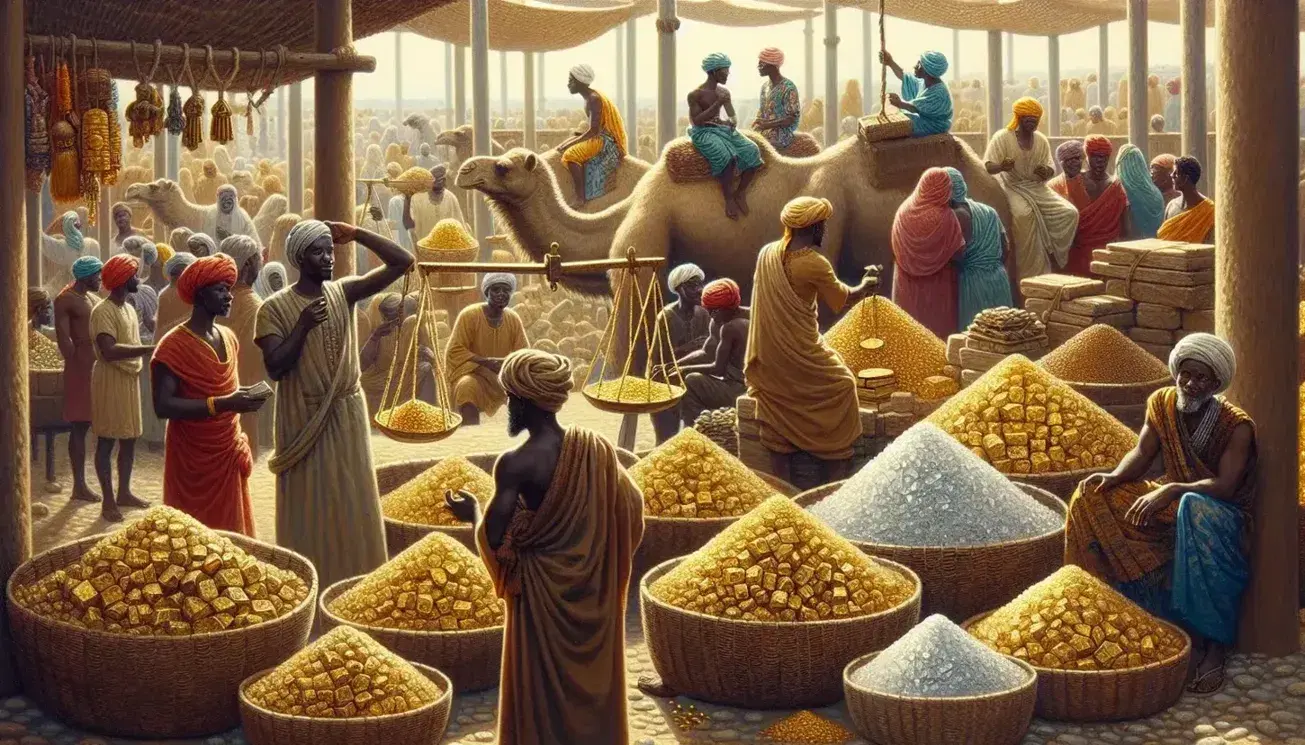
Long before modern mining or global markets, gold and salt were the twin pillars of one of history’s most influential trade networks: the trans-Saharan trade routes of West Africa.
From the 8th to the 16th century, caravans of up to 10,000 camels crossed the Sahara Desert, carrying gold from West African forests northward and returning with salt from Saharan mines. This exchange wasn’t just about commerce—it built empires, founded cities, and connected Africa to the Mediterranean, Middle East, and beyond.
Why Gold and Salt?
At first glance, pairing gold—a precious metal—with salt—a common mineral—seems odd. But in medieval West Africa, salt was as valuable as gold, for practical and economic reasons:
- Gold was abundant in the forests of present-day Ghana, Mali, and Burkina Faso, but had limited local utility beyond ornamentation and royal tribute.
- Salt was scarce in the south but essential for preserving food, flavoring meals, and maintaining health in hot climates. In some regions, salt was used as currency.
The result? A near-perfect trade:
“In the north, gold was king. In the south, salt was life.”
Arab and Berber traders from North Africa brought salt slabs from mines like Taghaza and Taoudenni deep in the Sahara. In return, West African kingdoms offered gold dust and nuggets from the Birimian and Ashanti goldfields—regions still rich in gold today.

Empires Built on Gold and Salt
Three great West African empires rose to power through control of this trade:
1. The Ghana Empire (c. 700–1200 CE)
- Called the “Land of Gold” by Arab scholars like Al-Bakri
- Did not mine gold directly but taxed trade—demanding a gold ingot for every salt slab entering the kingdom
- Capital Koumbi Saleh became a cosmopolitan hub with mosques, markets, and stone buildings
2. The Mali Empire (c. 1230–1600 CE)
- Reached its peak under Mansa Musa, whose 1324 pilgrimage to Mecca famously flooded Cairo’s markets with gold
- Controlled both gold fields (Bambuk, Bure) and trade routes
- Founded Timbuktu, which became a center of Islamic learning, commerce, and book trade
3. The Songhai Empire (c. 1460–1591 CE)
- Expanded control over the Niger River and trans-Saharan routes
- Used gold to fund a powerful navy and professional army
- Fell only after a Moroccan invasion armed with European cannons
These empires proved that control of trade—not just resources—creates power.
The Caravan Routes: Arteries of Civilization
Major trade corridors included:
- Sijilmasa (Morocco) → Awdaghust → Koumbi Saleh (Ghana)
- Fez (Morocco) → Walata → Timbuktu (Mali)
- Tripoli (Libya) → Agadez → Gao (Songhai)
Journeys took 40–60 days, with caravans navigating dunes, oases, and bandit threats. In Timbuktu and Djenné, goods were exchanged in bustling markets where gold dust was weighed against salt bars—sometimes at near-equal value.
Legacy of the Gold-Salt Trade
- Urbanization: Cities like Timbuktu, Djenné, and Gao flourished as trade and intellectual centers.
- Cultural Exchange: Islam spread peacefully through traders, leading to mosques, universities, and Arabic-script manuscripts (like the famous Timbuktu manuscripts).
- Global Awareness: Arab and European maps began depicting West Africa as a land of immense wealth—sparking later European exploration.
- Economic Models: Taxing trade (not production) became a blueprint for African statecraft.
Ironically, this very wealth attracted Portuguese and later European colonizers, who sought to bypass the Sahara by sailing around Africa—ultimately ending the caravan era.
Africa’s Gold Legacy Continues Today
The regions that supplied gold in the medieval era—Ghana, Mali, Burkina Faso, and Côte d’Ivoire—remain top global producers. In fact:
- Ghana is now Africa’s #1 gold producer
- The Birimian Greenstone Belt (source of ancient gold) still yields millions of ounces annually
- Timbuktu’s descendants live in a region where gold mining supports local economies
Yet today’s trade is governed by certifications, refineries, and export laws—not camel caravans. Responsible buyers now seek ethical, traceable gold that honors this historic legacy without exploitation.
How BUY GOLD AFRICA Connects Past and Present
Based in Johannesburg, BUY GOLD AFRICA sources gold legally from modern African producers in South Africa, DRC, Tanzania, and Botswana—regions with their own deep mining histories.
While not directly tied to the trans-Saharan routes, the company embodies a modern principle from that era: fair, transparent exchange.
With over 1.4 metric tons exported since 2014, BUY GOLD AFRICA ensures every gram is:
- Assay-certified (99.5%–99.99% purity)
- Legally sourced with full documentation
- Exported compliantly to global markets
It’s a far cry from salt-bartering—but the spirit of trusted trade endures.
Final Thought
The Africa gold and salt trade reminds us that value is shaped by need, scarcity, and connection. What was once measured in camel loads is now traded in metric tons—but Africa’s role as a global gold heartland remains unchanged.
Honor History. Source Responsibly.
Whether you’re an investor, refiner, or jeweler, choose a partner who respects Africa’s gold legacy.
Visit buygold.africa or contact BUY GOLD AFRICA at sales@buygold.africa for ethically sourced, certified African gold—delivered with professionalism and historical awareness.
From the caravans of Timbuktu to the refineries of today—gold with integrity.